
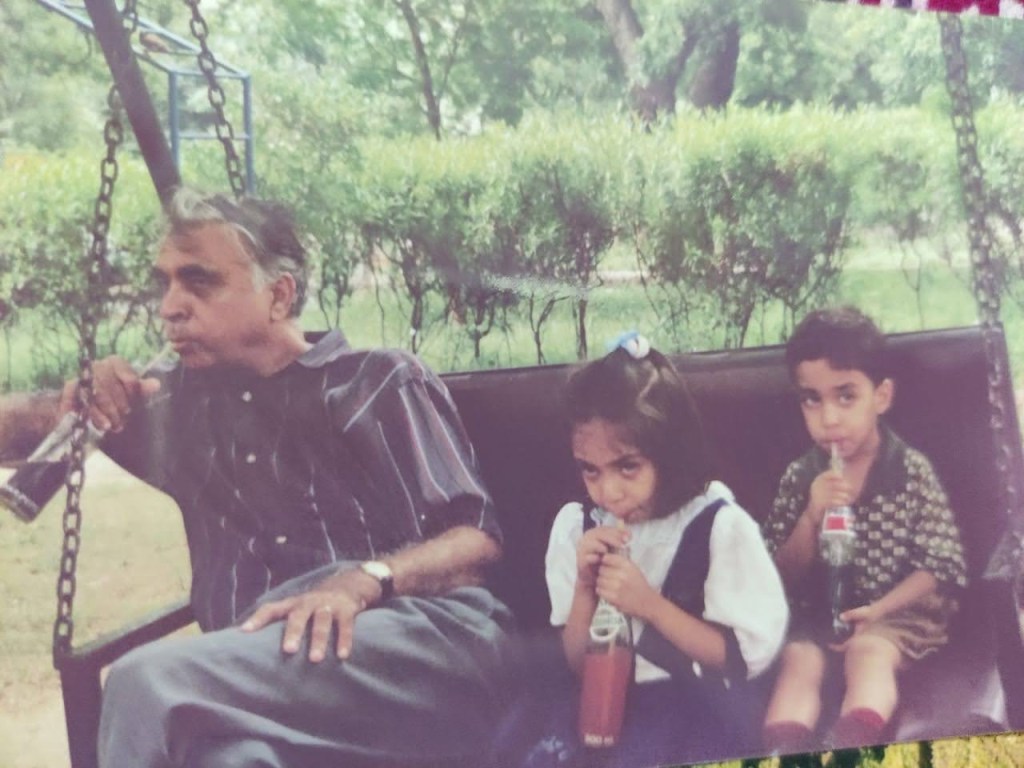
My maternal grandfather (nana) has always lamented one thing about my writing – that I never write about him, and his side of the family (my mother’s). Perhaps it’s true. I don’t, because I stop the memories from coming to the surface, given the complicated nature of our relationship. I have always loved freedom. He has always sought to control me (and failed miserably at it). You see. It feels nothing now, writing this, as the pain of adolescence has finally evaporated, till the last drop.
How am I so certain of it?
Last week, I sent him a meme. And it dissolved the last drop of negativity I’ve carried in my heart, filling it will something else – Love. I can see the memories bubbling now, and perhaps it’s good that he’s still alive (and still so damn proud). Perhaps he won’t give me unwarranted feedback on my writing now, and tell me how my sentences can be “shorter”. If he does, I’ll disregard it anyway.
I am six, and seated in his Maruti 800, as he drives to a bakery he always frequents to buy brown bread. I always accompany him to Standard Bakery, looking forward to only one thing – eating the Blue Bunny ice cream. It’s a ‘good day’ for the six-year-old me, as I return home with my tongue either blue or green, depending on the flavour of the ice lolly I have devoured. It’s blue today. There’s a boxy Mother Dairy kiosk a few hundred metres from his government quarters (a colonial mansion) in Pusa, New Delhi. It’s post dinner time, and we drive there, to buy packs of Kesar Pista kulfis for everyone. It’s a ritual, as ‘diabetes’ hasn’t entered our subconscious yet. It’s morning, and there’s a line outside the Dairy, with people lining up with their steel containers to get milk. The quarters jingle in his pant pockets, as he puts his hand inside to give them to me. It’s my turn now, and as my child brain marvels at this ‘cool’ invention, I slide the quarters in the slim opening, one after the other, waiting to see the thin stream of cold white liquid fall into my container. It still amazes me. He’s an important government man, with a white ambassador and a dark-skinned driver, Harish, who comes to pick him every day for work. I am inside his ambassador and the smell of the starched white seat covers engulfs me, while the tiny blue fan fitted in the corner, cools the sweat beads off my forehead. There are huge trees outside the house, looming large on the road, forming a canopy. Long blades of dried beans dangle from them, while the extra-dried ones fall onto the ground with a slight pat on the tarmac. I pick one up and shake it. It’s the sound of the magic beans. I split it open, and the beans fall on the ground. It’s a good day again. There’s a frail ‘maali’ (gardener) entering the house on his cycle as I swing from the main gate, my tiny feet between the wooden panels. He greets me. I keep swinging.
It’s peak summer, and the mango trees in the garden are laden with green, raw mangoes. My grandmother thinks it’s a good day to make Aam Panna (mango sherbet). The helpers have collected the mangoes in a basket, and the kitchen is intoxicated with a sweet, tangy aroma wafting around. Mangoes are peeled, boiled, and made into a thick paste. The grandmother is intuitively adding spices and running a ladle over the paste to strain the concoction. It’s time consuming, but she has nothing else to do. I watch her, like I watch everything else. What else does a six-year-old kid who hates being bored do? I step outside, and the green grass expands in front of me, with a huge palm tree in the middle. I forget I’m in Delhi. It’s an island. My own. I walk to the Chrysanthemums lined inside huge planters, on the edge of the garden, separating the garden from the verandah. The gardener has just watered them, and the resulting coolness travels inside my veins. I feel light, and one with the elements. I can taste the soil in my mouth.
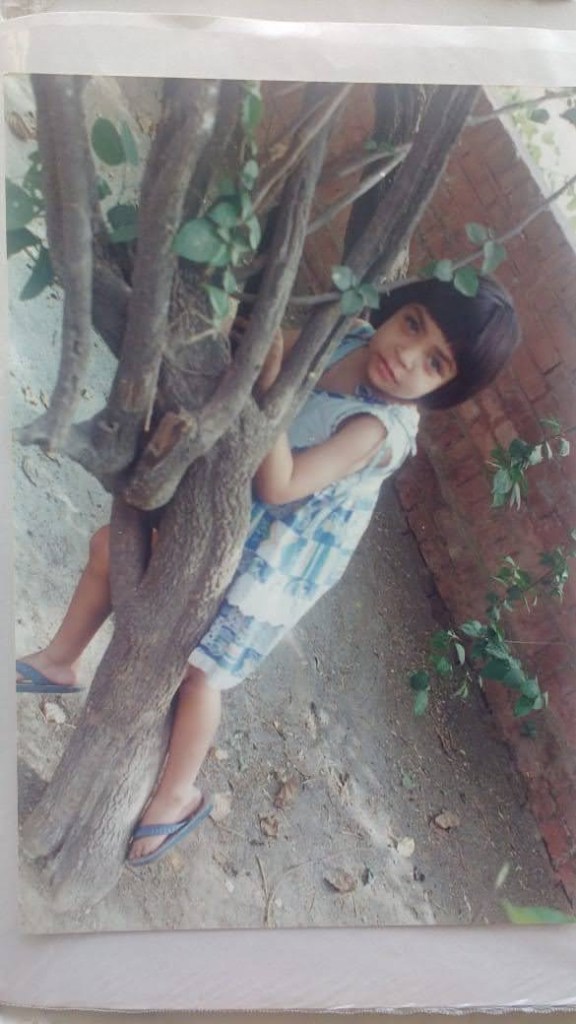
It’s pizza day at home, as grandmother’s new microwave is sitting idle. She finds recipes without any fuss. Perhaps she notes them down from the Tarla Dalal show she keeps watching on television. She makes vegetarian pizza, with tomato puree as the base sauce, adding green capsicums, onions, and Amul mozzarella cheese. I grate the cheese. The microwave now perpetually smells of pizza. And her hands. Everyone loves the pizza, and it becomes a permanent addition to her dinner menu. We go for jewellery shopping, as she needs new bangles made. We’re inside Tribhuvandas Bhimji Zaveri, a huge white sparkly palace, that sells old women a purpose – to collect heirlooms to pass down generations, so that if one day the daughter is kicked out of her husband’s home, she can atleast sell the gold. Or if one day the daughter wants to open a restaurant, she can atleast sell the gold. There’s a huge pond inside the store, with fish swimming in it. I keep staring at the fish, while my family stares at gold patterns. It’s a good day.
We’re in Karol Bagh, a cramped shopping neighbourhood, with clothes piled to resemble small mountain tops. Everyone is hurried, and we have too many things to buy – tops, jeans, socks, and so many random things we see on the way. We’re hungry. It’s time to go to ‘Raffles’; a shiny two-storied restaurant with things like Chinese Platter on their menu. My grandmother loves Chinese and we order two. She doesn’t talk much. I don’t need her to talk. The others are busy shopping, as we dig into our fried rice, hakka noodles, and manchurian. It’s a good day.
It’s picnic day, and my grandmother is in a visible rush, packing casseroles of biryani, chicken curry, aloo jeera, puris, and more. Things are stuffed in the back of the Maruti, and we’re in Nehru Garden. I take a long solitary walk, to see every flower, tree, and leaf there, while my family adjusts itself on the huge bedsheet, busily taking out the food containers. I come back once I’ve seen it all. I’m happy, and eat my food. Everyone is bugging me to eat more. I frown and think of leaving again. Perhaps I missed some trees.
It’s 5:30 am in the morning, and my grandmother is dressed in a green cotton suit, lacing up her shoes. She’s just joined a yoga group in the neighbourhood. I’m awake, ready to accompany her, and watch old, hefty, and well-rounded aunties, with huge butts attempt yoga asanas. It’s fun, and I have nothing else to do. One day something terrible happens in the yoga class. An aunty farts in the middle of her asana, and my grandmother has never been the same again. She is relating this incident to everyone she meets, while giggling like a school girl. She’s bursting with laughter that’s making her sides ache, and even the mere thought of this incident is enough to induce a violent fit of helpless laughter. It’s the longest running joke in the family now, and I start to feel a little bad for the woman at whose expense we’ve burnt too many calories. I am beginning to feel that perhaps it’s a little abnormal to do this to someone. I can’t help laughing. Nor can my grandmother.
It’s the middle of the night, and grandfather has come back from a trip to Bhutan. He has two huge containers filled with the reddest of apples I’ve ever seen. We eat apples all day, the next day. We’re doing particularly nothing, when he comes back from Tajikistan, another work trip. He’s got a white shirt for me; a full-sleeved shirt with white, round cuff-buttons, and cut-out patterns, giving it a modern look. I love it. To match with it, he’s got a white hair tie, shaped like a bow. It’s too big for my small egg-shaped head. I still love it. There are guests and friends always visiting him. People from his work, the countries he’s been to, and people he can’t shake off. His friend Chandu comes in the last category. A regular annoyance to my grandfather, he can’t help but still talk about him. He doesn’t like him, or his “loose” moral values. But his presence is still nice for him. It’s a love hate relationship. He calls Chandu a womanizer, and still doesn’t ban him from the house. A foreigner friend of grandfather is visiting him. He gets me a huge packet of Skittles. The red packet has happiness written all over it and a huge fact – that I am special. I like this feeling. Maybe because no one sees me in this house, and I spend long hours by myself in the garden, with my toys, outside the home, loitering, or reading. I feel seen. I love Skittles.
I’m fourteen, and it’s Book Fair day, and my father is as peppy as I am. His face is always buried behind people like Agatha Christie, John Grisham, Robert Ludlum or Sidney Sheldon. These people don’t interest me, and a short attempt to read their work wears off quickly. I am not into massy/pulpy thrillers or mystery novels like he is. We head to Pragati Maidan, a religious experience for both of us. I force him to slow down, and not skip any stall. I want to go through them slowly, from start to end. He wants to finish it fast. It’s a good day.
Father is watching a match as usual, dressed in his white kurta pyjamas. His feet rest on the edge of the bed, spotless, and crack-free, unlike my mother’s. It’s his genes. His hands are holding an empty dinner plate, now filled with food remnants and guilt. I get up to keep my plate in the kitchen, when he slyly says “keep this too, will you?” He doesn’t like asking for help, yet wishes someone would offer without him asking for it. He’s complicated, but not enough. I make a face, and take his too, making sure he knows I don’t like doing it. I am not a “good child” by any measure. I like troubling him too much for his own good. I tell him the truth, something he wishes to be ignored, and not pointed out. He fails at it, and resents my sharp tongue. What’s an eighteen-year-old girl who’s got so much to figure out, to do?
It’s weekend, and he’s decided to clean the house, as mother is busy painting. He starts with the curtains first, propped up on a stool, pulling out one curtain ring after the other. He’s sweaty and exhilarated. Fans have been wiped, drawers have been sorted, and documents have been torn. He’s bathed, combed and ready with his coffee and paper. He needs no one now. He is deaf now. He’s lying next to me, and I ask him about his life. His back is turned towards me, and he says “I don’t know how to talk. I’m an introvert. You talk about what’s going on.” He speaks few things like how his father never spent time with him, and him being raised by his brothers. He does a lot for them. He’s never sad around them, but filled with extra energy. It hurts him when I don’t make an attempt to stay connected with his family. I’m not a “good kid” by any of his measures. I’m self-absorbed, anti-social, and selfish to the core.
My mother’s voice pricks my ears. Her normal voice also feels shrill at times, and I wish to be left alone. She hovers over me like a helicopter, not having anything of her own. She cooks, cleans, and walks for someone else. She’s not happy unless she’s talking to my grandfather, or painting. Her constant commentary while watching something annoys me. My brother yells at her, and still she continues. She laughs like a child, seeing us annoyed with her. She can’t help herself. She expects me to help her with house work. I don’t. She makes tea, and expects me to like it. I don’t. She zones out while watching anything with me. I dislike going out with her, as she cannot wait to get back home. It angers me. My face is red. My father is deaf.
She sleeps in the afternoon, telling me to turn off the television. She has a headache. She always has a headache. It’s 2 am in the night, and she knocks on my door, because she can’t sleep, and won’t let me be. I don’t know how to love her, but I know I don’t hate her. I am ten, and we’re making pop-up cards together. She’s good with art and crafts. She teaches me origami, and buys me square-cut coloured papers. She makes little people out of them, and I know I can never be as good as her. I’m twenty, and my friends have come for a sleepover. She makes them sing, and I feel embarrased by her. My friends like her surprisingly. She puts sprouts in my noodles. I hate them. I remember that she makes a good malai kofta. I feel peace.
.
 wanderwomanwrites
Leave a comment